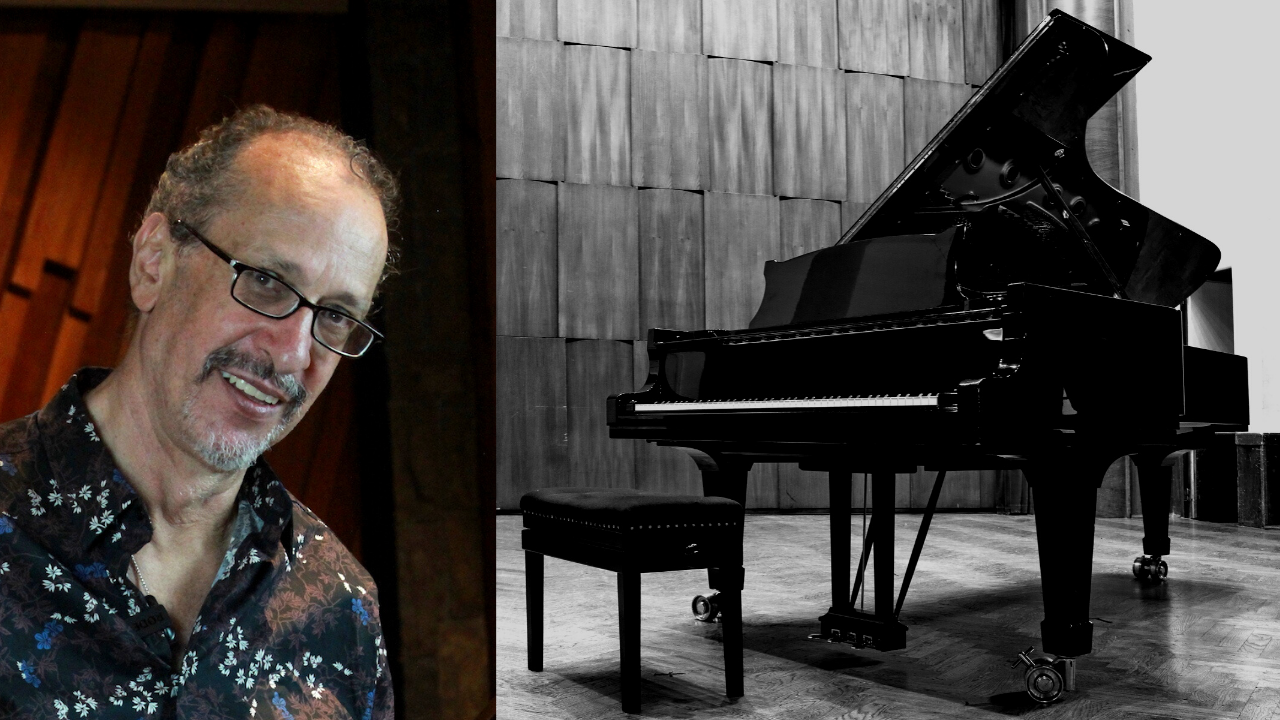
The composer's piano course is divided into 10 different modules, each of them delving into a specific subject matter.
COACHING SESSIONS (NOVEMBER 2021)
AND DECEMBER 2021
The 10 modules are interrelated and interdependent. However, in each of these, we deal with some very important matters relating to the piano as a tool of composition and for learning improvisation. The first module describes the three main responsibilities and roles of the music creator: the composer, the arranger and the orchestrator. You will gain insights into the individual roles of each, and how they combine to make the music creator, the person who is capable of creating beautiful musical content. In the second module, we deal with the role of the composer as a music creator; the composer ideally combines all of these three roles and but the focus is more on a very essential part of the composition, namely the melody, which is mostly at the center of each composition, and also harmony and rhythm. After this we deal with the arranger, usually the same person who structures the musical ideas around the melody, maybe introducing a secondary melody, maybe a counter-melody, possibly a harmonic context, or a rhythmical context that gives the composition a specific rhythmical movement. So all the elements of the composition, and not only the melodic concept, are dealt with by the arranger. And the form is another important part of the arranger’s role.
And then there is the orchestrator, whom we concentrate on in the third module. The orchestrator uses his knowledge of the characteristics of each instrument available to the composer, in order to create the colors and the contrasts as well as the range of possible textures of the composition. And so we have the roles of the composer, the orchestrator and the arranger which were explained in the first module. In the other modules we go into more detail on these matters.
We have a module dedicated to rhythm, to what I call the rhythmic scaffolding. This you can use to take advantage of the many rhythmical traditions of different cultures in the world. Not only in the jazz tradition, but in the whole world of music that you can use to make music more interesting. You do this by utilizing melodic variations in rhythmical terms, also the harmonic rhythm and their accompaniment. Everything connected with the rhythmical concept in the composition is dealt with in this fifth module. This is followed by a module dedicated to very specific components that I'm often asked for and are related to Latin American music, mostly in the Afro-Cuban and Caribbean music language. We also deal with these very specifically as they are related to the piano; however, they can be also used in composition terms and as well as with other instruments. We will see that not only harmonic instruments can be used but also, as is apparent in the orchestral works of Chavez and Tanya Leone and many other composers, that these elements of piano and guitar accompaniment can be employed in compositions for orchestra and probands.
Presentation
The creator of music, usually called composer, ideally masters and combines three different albeit overlapping and interdependent sets of skills: the composer, the arranger and the orchestrator, what I like to call “The Trident”. This module describes each of this three areas in general terms, and how they interact and are interwoven in the person creating musical content.